Internal knowledge search
Over procedures, policies and internal documentation.

02 · RAG systems
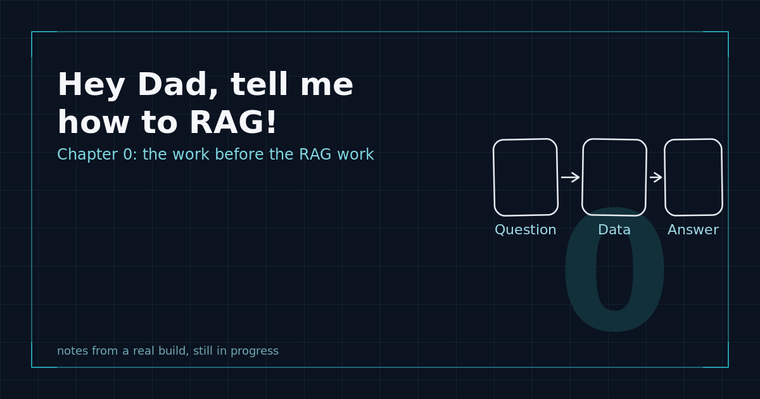
RAG (retrieval-augmented generation) lets an AI assistant answer questions from your own documents and data, and show the sources it used. We design, build and hand over RAG systems for growing companies, starting with the work most projects skip: getting the content ready.
In one paragraph
The system first finds the relevant parts of your documents, then an AI model writes the answer from those parts and shows where they came from.
It fits when your teams spend time searching procedures, policies, tickets or product documentation. Read our RAG readiness checklist
What we build
Over procedures, policies and internal documentation.
Based on product documentation.
Such as contracts or specifications.
Integrations that bring answers into the tools your team already uses.
Who it is for
The Technical Diagnostic maps your systems, data and workflows in 2–3 weeks and tells you what to build first.
See the Technical Diagnostic →How we work
Four steps, from readiness to a system your team owns.
We check AI maturity, data ownership, maintenance, trust and compliance, and whether to build or buy.
Document ingestion, retrieval, answers with sources and access control, built with LlamaIndex and Python.
We check answers against a set of questions with known answers before anyone relies on the system.
Documentation, named owners for the content, and a process to keep it current.
Tools
Related services
Most projects touch more than one area.
FAQ
Not sure where to start? The Technical Diagnostic is the first step for every build.
RAG fits when answers must come from documents that change and need sources. Fine-tuning changes how a model writes or behaves; it is not a good way to keep it up to date with your knowledge.
We start with the 2–3 week Technical Diagnostic. The build runs in sprints of 4–6 weeks; the scope depends on how ready your content is.
Each content area has an owner, documents are updated through a defined process, answers show their sources, and we test against known questions after changes.
We are based in the EU and work with GDPR in mind. Where your data is stored and processed is agreed with you during the diagnostic.
The build is scoped after the diagnostic. See the Technical Diagnostic
Proof




“Mateusz has a unique ability to bridge the gap between marketing, sales, and tech. He brings a rare mix of technical acumen and strategic thinking that consistently pushed our projects forward.”
A 30-minute call. We’ll tell you what we’d build first.
What happens next